

Choosing the right EDI approach can make or break how smoothly you connect with your trading partners. With so many methods available, it’s important to remember that no single option works for every business. The key is understanding which type of EDI best supports your goals, your processes, and your trading community.
This blog will walk you through the most common EDI methods and help you identify the best fit for your organization.
Table of Contents
Types of EDI Solutions
Understanding the different types of EDI solutions is the first step in choosing the right approach for your organization. Here’s a breakdown of the main options:
Cloud-Based
Cloud-based (or web-based EDI) solutions enable businesses to exchange documents with trading partners from anywhere, without the need for extensive IT infrastructure or large data centers. However, these solutions often still require internal management and technical expertise, which can be challenging for organizations without dedicated IT resources. Additionally, when working with an EDI provider that relies on cloud infrastructure, service outages can and do occur, and the provider often has limited control over cloud availability.
In-House
An in-house EDI approach provides full control over operations, but for most organizations, it is neither practical nor cost-effective. Successfully managing EDI internally requires a dedicated team of highly skilled IT professionals, ongoing system maintenance, continuous monitoring, and regular staff training. EDI is not a “set-it-and-forget-it” function; it demands 24/7 support, including nights, weekends, and holidays to address failures, partner changes, compliance updates, and errors.
The true cost of in-house EDI extends far beyond software and infrastructure. Downtime, errors, or missed transactions can disrupt supply chains, delay orders, and damage trading partner relationships. For these reasons, most organizations find that maintaining EDI in-house introduces unnecessary risk and operational burden compared to leveraging specialized EDI service providers.
Self-Service
Self-service EDI models position themselves as a flexible middle ground, allowing businesses to manage many EDI functions independently while relying on limited provider support. In practice, however, most organizations quickly discover that this approach is far more time-consuming and complex than anticipated, especially for companies with higher transaction volumes.
Self-service EDI requires hands-on involvement at nearly every step, from setup and partner onboarding to troubleshooting errors and managing ongoing changes. Organizations without a dedicated EDI team often become frustrated as they realize how steep the learning curve is and how frequently issues arise. While marketed as a cost-saving option, self-service models often lead to escalating fees for additional support, upgrades, and problem resolution. Over time, many businesses find themselves paying increasingly. Ultimately transitioning to a fully managed service anyway.
Without in-house EDI expertise and the capacity to manage ongoing demands, self-service EDI is rarely a practical or sustainable solution.
Fully Managed
A viable Managed EDI Service provider will host, maintain and service every aspect of what is required for a business to connect with trading partners, translate data, integrate and interrogate data to and from any-and-all customer formats and applications with flexibility, reliability, 24/7 availability. Most important, maintain all the professionally skilled resources required to manage each process on demand. A true fully managed EDI solution, like the one offered by Promethean Software Services, removes the burden from your team entirely.
This approach ensures smooth, reliable, and efficient EDI operations without the need for internal technical expertise.
Key Considerations
When selecting an EDI Managed Services Provider, consider these critical factors:
- Expertise: Look for a provider with proven experience in your industry and with your trading partners.
- Support: Choose a provider offering responsive, hands-on support, especially if you’re outsourcing fully managed EDI.
- Scalability: Your EDI solution should grow with your business, accommodating higher transaction volumes and new trading partners.
- Compliance & Security: Ensure the provider adheres to industry regulations and employs robust security protocols.
- Cost vs. Value: Evaluate the total cost of ownership, including hidden costs like training, maintenance, and support
Benefits to Selecting the Right EDI Provider
Choosing the right EDI approach can have a transformative impact on your business:
- Reduced Errors & Delays: Automated data exchange minimizes human error.
- Improved Efficiency: Fully managed EDI allows your team to focus on core business operations.
- Enhanced Trading Partner Relationships: Reliable EDI ensures smooth communication with suppliers, retailers, and distributors.
- Scalability: The right EDI system grows with your organization, supporting expansion seamlessly.
- Peace of Mind: Outsourcing to experts ensures your EDI operations are compliant, secure, and fully optimized.
Comparison Table of Different EDI Types
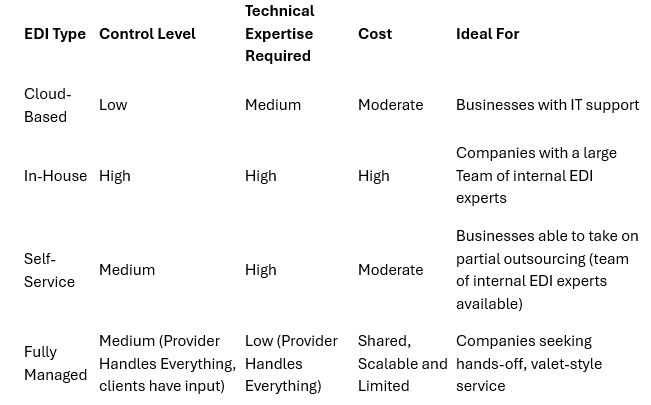
The fully managed EDI model at Promethean Software Services ensures that your organization receives top-tier service without the headaches of the other EDI types.
Conclusion:
A fully managed EDI solution is more than just a convenience. It’s a strategic advantage. Promethean’s performance on Gartner Peer Insights over the past year determined one-hundred percent of verified clients who left feedback said they would recommend our services and gave us an overall rating of 5.0 out of 5.0 stars for our EDI and VAN managed services.
If your goal is stress-free, fully managed EDI that grows with your business, Promethean Software Services is ready to be your trusted partner.